ammjohn.com.au
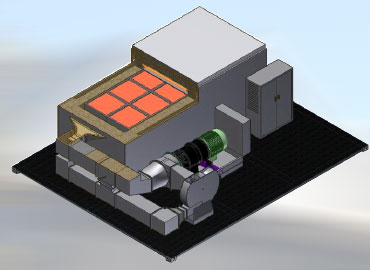
South Australia. Adelaide-based Ammjohn engineering consultancy company and last-year students at the University of Adelaide developed a device known as TESS. The government grant them 400.000 AUD in order to take it from industrial prototype to commercial product. It is a Latent Heat Storage Device working by sand, its most important material. TESS is based on the latent heat properties of the silicon derived from normal sand and it can store electricity as thermal energy by melting tanks full of silicon. Both the melting temperature and the high latent heat capacity of the sand silicon makes it ideal for storage of big amount of energy.
TESS Project Chief Executive Officer Jonathan Whalley said, and I agree, “Storage was and is the next big challenge for energy generation worldwide. Renewable Energy Sources generally spill energy due to supply and demand mismatches, so we have designed the TESS device to capture this ‘spilt’ energy for later use or release to the grid. Our system also means that energy consumers will be able to purchase stored electricity off-peak at low tariffs, which ultimately means cheaper energy.”
The TESS device is small enough to fit inside a normal shipping container, but is readily scalable, as demand requires. TESS is capable, theoretically, to handle an increasing workload from 500 kW through to an industrial scale of up to several hundred MW. It is suitable, moreover, for both grid and off-grid applications and has been designed to overcome the intermittent nature of RES, such as wind and solar, by providing a stable energy output. Of course it can be integrated anywhere within an electricity network and it could be suitable for commercial and industrial businesses where heat and electricity are required. A commercial TESS prototype should be ready in the first months of 2016 to be used as a selling tool to potential clients for individual sites.
Whalley said also, “Energy prices are increasing around the world while storage technology costs are reducing, so we’re approaching the tipping point where energy storage systems are finally becoming commercially viable. We are developing an energy storage system to meet market demand. We anticipate that this will result in exponential growth of the energy storage market worldwide”.
Nel design degli impianti di generazione rinnovabile, l'integrazione tra fonte primaria e sistema di accumulo…
Ricercatori dell'Università del Missouri hanno sviluppato un ceppo di alghe geneticamente modificate capaci di catturare…
Ricostruzione dettagliata del disastro nucleare di Chernobyl del 26 aprile 1986: difetti del reattore RBMK,…
Uno studio dell'Università di Manchester pubblicato sul Journal of Advances in Modeling Earth Systems ha…
Ci sono particelle di plastica nelle acque dell'Artico, nel cibo che mangiamo, nell'aria che respiriamo…
Il Ministero dell'Ambiente e della Sicurezza Energetica ha affidato a un consorzio guidato da e-GEOS,…